
You’ve probably heard the word “liberal” in news, debates, or even random conversations—and thought, what does it really mean?
Sometimes it sounds political. Other times, it feels more about personality or mindset.
I remember hearing it for the first time and thinking it had just one meaning—but it doesn’t.
The truth? “Liberal” can change depending on context. Let’s break it down in the simplest way so it finally makes sense.
What Does Liberal Mean?
“Liberal” means open-minded, supportive of freedom, and willing to accept new ideas or changes.
In politics, it refers to beliefs that support equality, individual rights, and social progress.
In everyday use, it can describe someone who is generous, flexible, or not strict.
Meaning & Definition
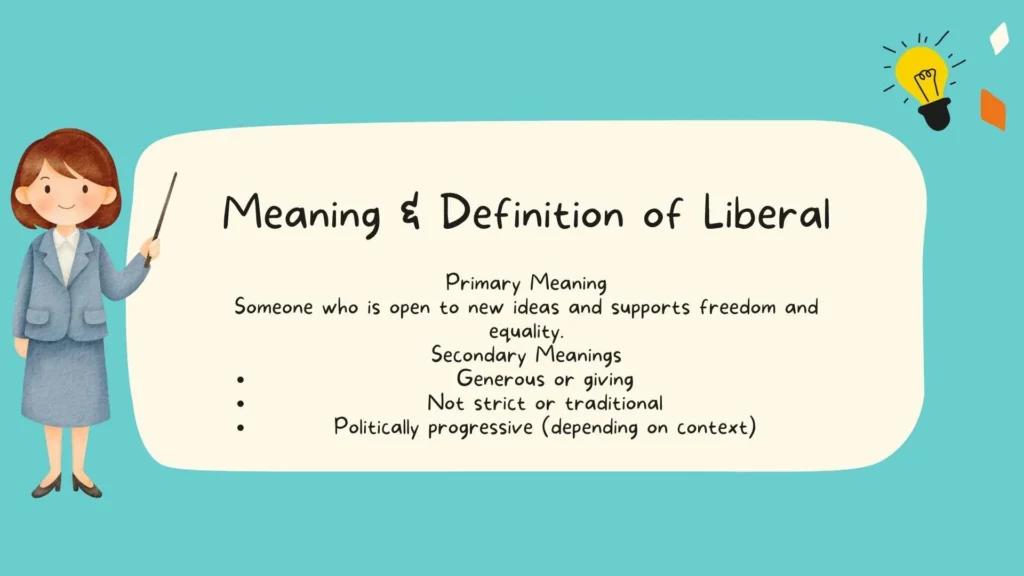
Primary Meaning
Someone who is open to new ideas and supports freedom and equality.
Secondary Meanings
- Generous or giving
- Not strict or traditional
- Politically progressive (depending on context)
Chat Examples:
- “My parents are pretty liberal about rules.”
- “He has liberal views on social issues.”
Background & Origin
The word “liberal” comes from the Latin word liber, meaning “free.”
Over time, it became linked to ideas of freedom, rights, and progress—especially in politics and society.
Today, it’s used in both everyday language and political discussions.
Does Liberal Mean Free?
The word liberal does not literally mean “free,” but it is closely connected to the idea of freedom.
A liberal generally supports individual rights, personal freedom, equal opportunities, and limited restrictions on people’s choices.
For example, a liberal may support freedom of speech, freedom of religion, and civil liberties. The exact meaning can vary depending on the country and context.
What is A Liberal in Politics
In politics, a liberal is someone who generally supports individual rights, social equality, civil liberties, and government policies that help address social and economic issues.
Modern liberals often support:
- Equal rights and anti-discrimination laws
- Environmental protection
- Public education
- Healthcare programs
- Social welfare initiatives
The definition can differ between countries. In some places, liberalism focuses more on economic freedom, while in others it emphasizes social progress and equality.
Conservative Definition
A conservative is a person who generally favors traditional values, established institutions, and gradual rather than rapid social change.
Conservatives often emphasize:
- Personal responsibility
- Limited government intervention
- Free-market economics
- Traditional social values
- National security
Like liberalism, conservatism can vary depending on the country’s political system and culture.
Liberal vs Democrat
Many people use liberal and Democrat interchangeably, but they are not exactly the same thing.
| Term | Meaning |
| Liberal | A political ideology or set of beliefs |
| Democrat | A member or supporter of the Democratic Party in the United States |
Most liberals in the U.S. tend to support the Democratic Party, but not every Democrat is equally liberal.
Likewise, some people hold liberal views without identifying as Democrats.
In simple terms, liberalism is an ideology, while Democrat is a political party affiliation.
Liberal-Minded Person
A liberal-minded person is generally open to new ideas, different perspectives, and social change. They often value tolerance, diversity, and personal freedom.
Characteristics may include:
- Open-minded thinking
- Respect for different lifestyles
- Willingness to consider new viewpoints
- Support for individual rights
- Acceptance of cultural diversity
Being liberal-minded does not necessarily mean belonging to a particular political party.
Liberal Meaning in History
Historically, liberalism emerged during the 17th and 18th centuries, particularly during the Age of Enlightenment.
Early liberals challenged absolute monarchy and argued for individual rights, representative government, and freedom of expression.
Key historical ideas of liberalism included:
- Freedom of speech
- Religious freedom
- Rule of law
- Private property rights
- Democratic participation
Over time, liberalism evolved and developed different branches, including classical liberalism, social liberalism, and modern liberalism.
While the details have changed, the central theme has remained the protection of individual freedom and rights.
Usage in Different Contexts
Casual Chats
Used to describe personality or flexibility.
- “She’s very liberal—she lets her kids choose freely.”
Social Media
Often used in discussions or debates.
- “People are arguing about liberal vs conservative again 😅”
Professional Use
Used in academic, political, or policy discussions.
- “The policy reflects liberal values.”
Gaming / Group Chats
Rare, but sometimes used jokingly.
- “Bro is too liberal with game rules 😂”
Meanings Across Platforms
| Platform | Tone | Example |
| Neutral | “He has liberal thinking” | |
| Opinionated | “Liberal mindset ✨” | |
| TikTok | Debative | “Liberal vs conservative trends” |
| Snapchat | Casual | “My parents are liberal lol” |
| Discord | Mixed | “That’s a liberal take” |
Real-Life Examples & Memes
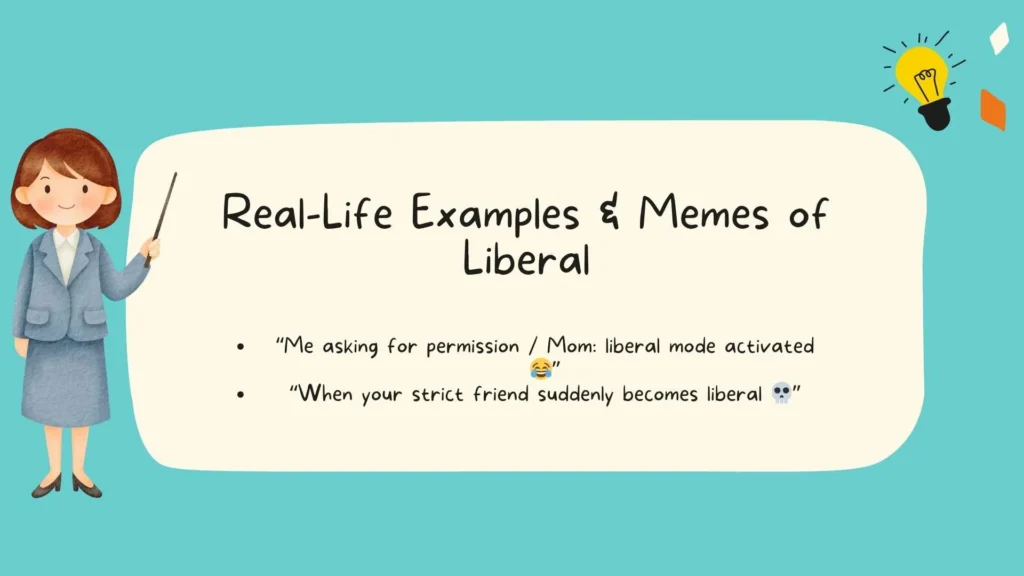
- “Me asking for permission / Mom: liberal mode activated 😂”
- “When your strict friend suddenly becomes liberal 💀”
Meme-style lines:
- “Liberal when it’s fun, strict when it’s exams 😭”
- “Everyone’s liberal until rules apply 😂”
Cultural or Regional Interpretations
US / UK
Strongly connected to politics—often linked to progressive ideas.
Asia (India, Pakistan, Philippines)
Used both socially and politically, but meaning may vary based on context.
Australia
Used similarly to the UK, but political meaning may differ.
Other Meanings
| Field | Meaning | Description |
| Politics | Progressive views | Supports equality and rights |
| Personality | Open-minded | Accepts new ideas |
| Behavior | Generous | Gives freely |
| Rules | Flexible | Not strict |
Common Mistakes & Misconceptions
- Thinking “liberal” always means political
- Assuming it’s always positive or negative
- Confusing it with “careless”
- Using it without understanding context
- Believing it has only one meaning
Psychological / Emotional Meaning
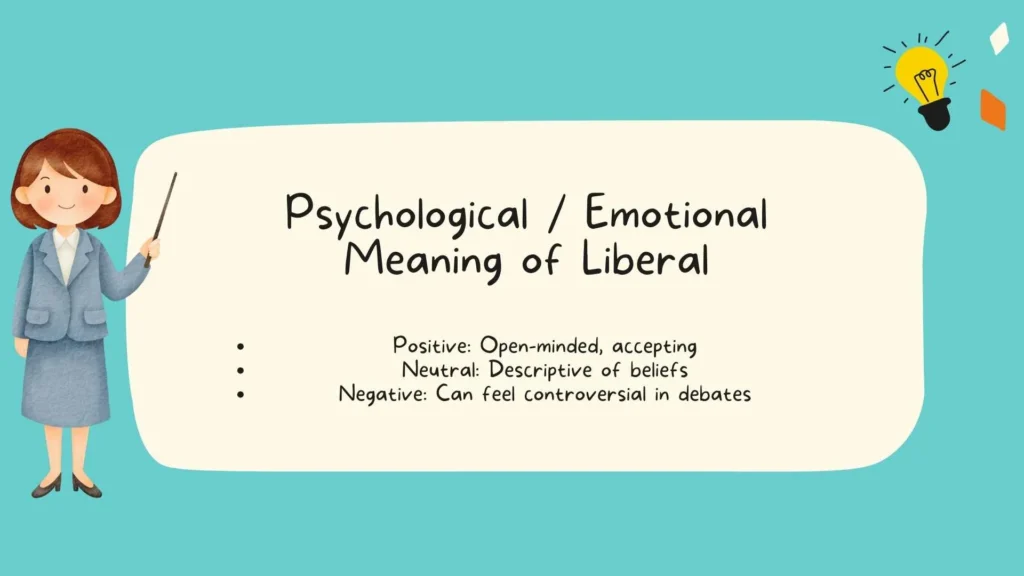
- Positive: Open-minded, accepting
- Neutral: Descriptive of beliefs
- Negative: Can feel controversial in debates
It often reflects how someone views freedom and change.
Similar Terms & Alternatives
| Word | Meaning | Tone |
| Open-minded | Accepting ideas | Positive |
| Progressive | Supports change | Positive |
| Flexible | Not strict | Neutral |
| Generous | Giving nature | Positive |
Is It Offensive or Friendly?
“Liberal” is not offensive by itself.
But in political discussions, tone matters—it can feel supportive or critical depending on how it’s used.
Grammar or Linguistic Insight
“Liberal” is an adjective.
It describes people, ideas, or behavior.
Example:
- “She is liberal in her thinking.”
How to Respond
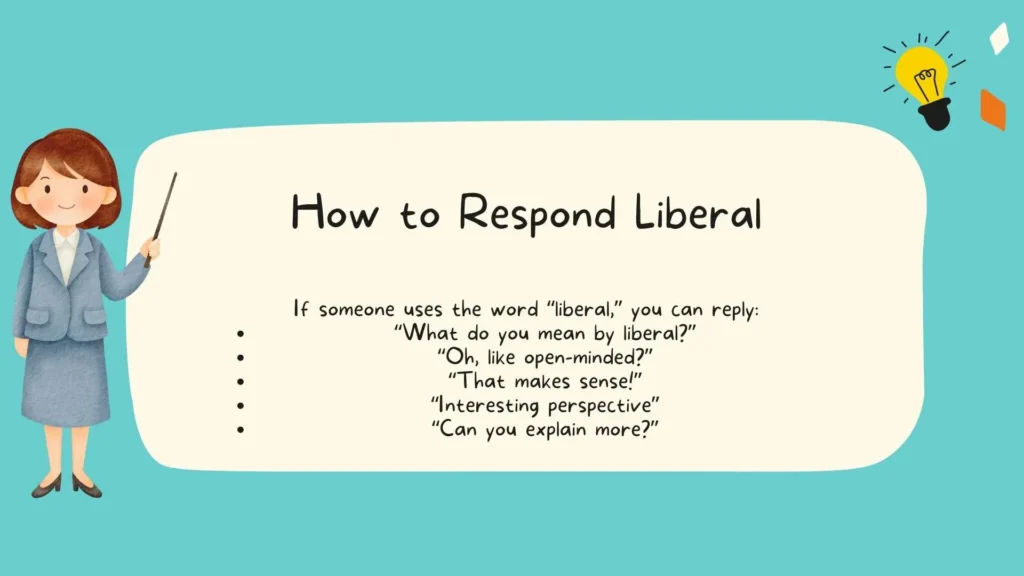
If someone uses the word “liberal,” you can reply:
- “What do you mean by liberal?”
- “Oh, like open-minded?”
- “That makes sense!”
- “Interesting perspective”
- “Can you explain more?”
Differences From Similar Words
| Term | Meaning | Difference |
| Liberal | Open-minded | Broad and flexible |
| Conservative | Traditional | Opposite in politics |
| Flexible | Adaptable | Less ideological |
| Generous | Giving | Focus on kindness |
Relevance in Dating & Online Culture
In dating, “liberal” often means:
- Open-minded personality
- Accepting different lifestyles
- Less strict about rules
Example:
- “Looking for someone liberal and understanding 💫”
Popularity & Trends
The word “liberal” trends during:
- Political discussions
- Social debates
- TikTok opinion videos
It’s often used to express identity, beliefs, or personality.
When NOT to Use “Liberal” (IMPORTANT)
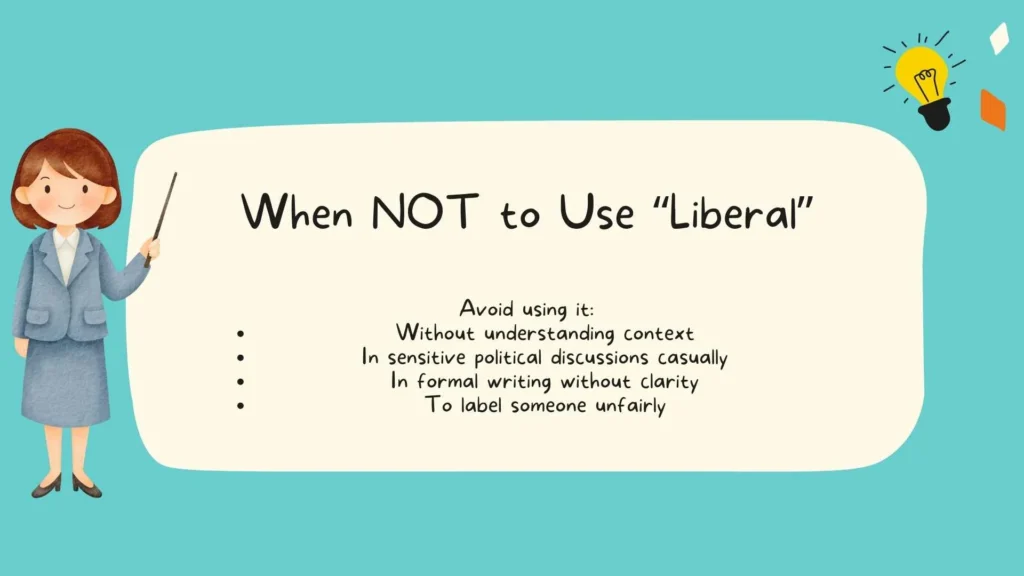
Avoid using it:
- Without understanding context
- In sensitive political discussions casually
- In formal writing without clarity
- To label someone unfairly
It’s a powerful word—use it carefully.
FAQs
What does liberal mean in simple words?
It means being open-minded, accepting new ideas, and supporting freedom.
Is liberal a political term?
Yes, but it can also describe personality or behavior.
Does liberal mean generous?
Yes, in some contexts it means giving or not being strict.
Is liberal positive or negative?
It depends on context, generally positive but can be debated.
What is the opposite of liberal?
Conservative, which focuses more on tradition.
Conclusion
“Liberal” isn’t just one simple meaning—it’s a mix of openness, freedom, and flexibility. Sometimes it’s about politics, sometimes personality.
The key is understanding the context. And honestly, a little openness in life? That’s never a bad thing 😊
Also Check These Posts:
- What Does “Shipment Exception” Mean The Truth Behind That Scary Tracking Update for 2026
- What Does “PO” Mean in Medical Terms A Simple Guide You’ll Actually Understand for 2026
- What Does “SH” Mean The Real Meaning Behind This Short but Powerful Text for 2026

Ava Grace is a passionate writer who believes in the power of words to heal, inspire, and uplift. Through Quoteliy.com, she shares daily doses of motivation, love, and positivity to brighten your day. Her mission is to turn simple quotes into meaningful moments that connect hearts and spark hope.