
You’ve probably heard the phrase “Allahu Akbar” in movies, news, prayers, or even social media clips but many people don’t truly understand what it means.
For some, it sounds familiar but unclear. For others, it’s often misunderstood because of how it appears in media headlines.
In reality, this phrase is deeply spiritual and widely used by over a billion Muslims around the world in everyday life, prayers, and moments of gratitude.
This guide breaks it down in a simple, respectful, and human way so you can understand its real meaning without confusion or stereotypes.
Based on cultural and linguistic understanding, here’s what it truly means.
What Does Allahu Akbar Mean?
“Allahu Akbar” is an Arabic phrase that means “God is the Greatest.”
It is used by Muslims in daily prayers, moments of gratitude, surprise, or strong emotion.
The phrase expresses faith in God’s greatness and is commonly spoken in religious and everyday situations.
Meaning & Definition of Allahu Akbar
The phrase “Allahu Akbar” comes from Arabic:
- “Allahu” means “God”
- “Akbar” means “greater” or “greatest”
Primary Meaning:
God is the Greatest
Secondary Uses:
- Expression of gratitude
- Expression of amazement
- Used in prayer (Salah)
Real-Life Examples:
- “Allahu Akbar, I passed my exam!”
- “Allahu Akbar” said during prayer
Chat Example:
- Friend: “You got the job?”
- Reply: “Yes! Allahu Akbar 🙏”
Background & Origin of the Phrase
The phrase Allahu Akbar originates from classical Arabic and is central in Islam.
It has been used for over 1,400 years, dating back to the time of Prophet Muhammad (peace be upon him).
Why people use it:
- To express faith in God
- During prayers (five daily Salah)
- In emotional or powerful moments
- To show gratitude or relief
It is one of the most commonly spoken phrases in the Muslim world.
Usage in Different Contexts
Casual Chats
Used in joyful or emotional moments:
- “I finally got my result, Allahu Akbar!”
Social Media
Often used in captions or emotional posts:
- “New beginning, Allahu Akbar ❤️”
Professional Use
Rare in professional environments, but may appear in cultural or religious contexts.
Gaming / Group Chats
Sometimes used jokingly among friends (in respectful tone):
- “We won the match, Allahu Akbar 😂”
Meanings Across Platforms
| Platform | Tone | Example |
| Emotional | “Allahu Akbar, thank you God 🙏” | |
| Inspirational | “Allahu Akbar, blessed day ✨” | |
| TikTok | Emotional / Viral | “Allahu Akbar moment ❤️” |
| Snapchat | Casual | “Allahu Akbar 😭 I can’t believe it” |
| Discord | Friendly chat | “Allahu Akbar we won!” |
Real-Life Examples & Memes
Chat-style examples:
- “Got accepted into college. Allahu Akbar 🙌”
- “After so much struggle… Allahu Akbar”
Meme-style lines (light humor):
- “Me after finding my lost phone: Allahu Akbar 😭”
- “When WiFi finally connects: Allahu Akbar 😂”
Important note: It is always meant respectfully, even when used humorously.
Cultural or Regional Interpretations
US / UK
Often heard in news or multicultural communities; sometimes misunderstood due to media portrayal.
South Asia (India, Pakistan, Philippines)
Common in daily life among Muslim communities during prayer or emotional moments.
Australia
Used in multicultural contexts, especially in religious or family settings.
Across all regions, it carries the same core meaning: faith and gratitude to God.
Other Meanings
| Field | Meaning | Description |
| Religion | God is the Greatest | Core Islamic phrase |
| Linguistics | Arabic expression | Used in formal Arabic language |
| Culture | Faith declaration | Expression of belief |
| Emotion | Gratitude / shock | Used in emotional moments |
Common Mistakes & Misconceptions
- Thinking it has a violent meaning (incorrect)
- Assuming it is only used in serious situations
- Believing it is negative in nature
- Misunderstanding it due to media portrayal
- Using it without understanding cultural context
Psychological / Emotional Meaning
The emotional tone of Allahu Akbar depends on context:
- Positive: Gratitude, happiness, relief
- Neutral: Everyday expression in prayer
- Negative (misused context): Often misunderstood due to media bias
For believers, it brings peace, hope, and spiritual connection.
Similar Terms & Alternatives
| Word | Meaning | Tone |
| SubhanAllah | Glory be to God | Spiritual |
| Alhamdulillah | Praise be to God | Grateful |
| MashAllah | What God has willed | Positive |
| Allahu Akbar | God is Greatest | Powerful |
Is It Offensive or Friendly?
Allahu Akbar is NOT offensive.
It is a sacred phrase in Islam.
✔ Friendly use: “Allahu Akbar, I’m so grateful 🙏”
✔ Prayer use: During Salah
❌ Offensive only if misused in harmful context (media misuse)
The meaning itself is peaceful and spiritual.
Grammar or Linguistic Insight
“Allahu Akbar” is a comparative superlative structure in Arabic:
- Allahu = God
- Akbar = Greatest
So literally, it translates to:
“God is the Greatest”
It is one of the most powerful expressions in Arabic language structure.
How to Respond
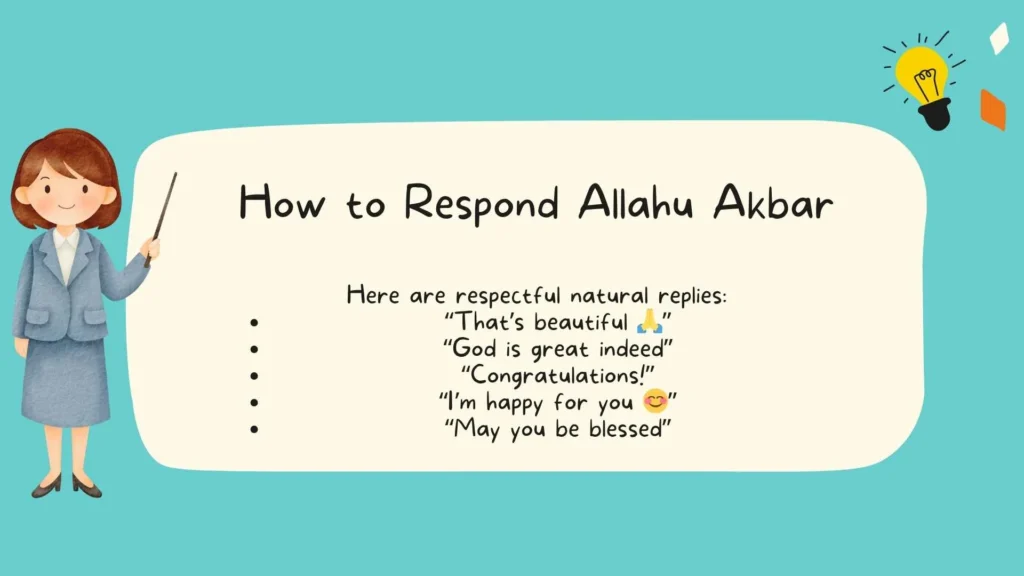
Here are respectful natural replies:
- “That’s beautiful 🙏”
- “God is great indeed”
- “Congratulations!”
- “I’m happy for you 😊”
- “May you be blessed”
Differences From Similar Words
| Phrase | Meaning | Usage |
| Allahu Akbar | God is Greatest | Expression of faith |
| Alhamdulillah | Praise be to God | Gratitude |
| SubhanAllah | Glory be to God | Wonder / awe |
| MashAllah | God has willed it | Admiration |
Relevance in Dating & Online Culture
On apps like Tinder or Bumble:
- Rarely used, but may appear in bios of religious users
- Shows cultural or spiritual identity
In Gen Z culture:
- Used in emotional memes
- Appears in TikTok captions
- Sometimes used humorously but respectfully
Popularity & Trends
On TikTok and Instagram:
- “Allahu Akbar moments” trend appears in emotional clips
- Used in storytelling videos
- Viral in gratitude or success moments
It remains a globally recognized phrase due to cultural and religious significance.
When NOT to Use Allahu Akbar
Avoid using it in:
- Mocking or joking disrespectfully
- Non-serious or sarcastic insults
- Political or violent misrepresentation
- Formal corporate jokes or memes that may offend
It should always be used with respect.
FAQs
1. What does Allahu Akbar mean in English?
It means “God is the Greatest” in Arabic.
2. Is Allahu Akbar a prayer?
Yes, it is commonly used in Islamic prayers and daily worship.
3. Is Allahu Akbar dangerous or negative?
No, it is a peaceful religious phrase. Misuse creates misunderstanding.
4. When do Muslims say Allahu Akbar?
During prayer, moments of gratitude, or emotional situations.
5. Can non-Muslims say Allahu Akbar?
Yes, but it should be said respectfully with understanding of its meaning.
Conclusion
The phrase “Allahu Akbar” is one of the most powerful and meaningful expressions in the Arabic language. It is not just a phrase; it reflects faith, gratitude, and spiritual connection.
While it is sometimes misunderstood in media, its true meaning is peaceful and deeply emotional for millions of people worldwide.
Understanding it helps build respect, awareness, and better communication across cultures.
At its heart, it simply reminds people of one powerful truth: God is the Greatest.
Also Check These Posts:
What Does DND Mean? The Simple Meaning Behind This Common Text Slang (2026 Guide)
What Does Celibate Mean? The Real Meaning, Truth and Modern Use Explained Simply (2026 Guide)
What Does N/A Mean? The Simple Meaning You See Everywhere but Never Notice

Isabella is a passionate soul who finds beauty in words and meaning in every emotion. Through Quoteliy.com, she shares uplifting quotes that celebrate love, strength, and inner peace. Her writing reflects a heart that believes in healing through hope and inspiring others to see the light in every moment.