

If you’ve ever been texting a friend or scrolling through social media, you’ve probably seen WBU pop up in a message.
But what does it really mean? Is it just another random abbreviation, or does it carry a specific conversational purpose?
In this article, we’ll break down everything about WBU, including its meaning, origin, how to use it properly, and even how it’s understood in the context of NLP and online semantics.
By the end, you’ll feel confident spotting and replying to WBU like a pro.
WBU Meaning and Full Form
Definition of WBU
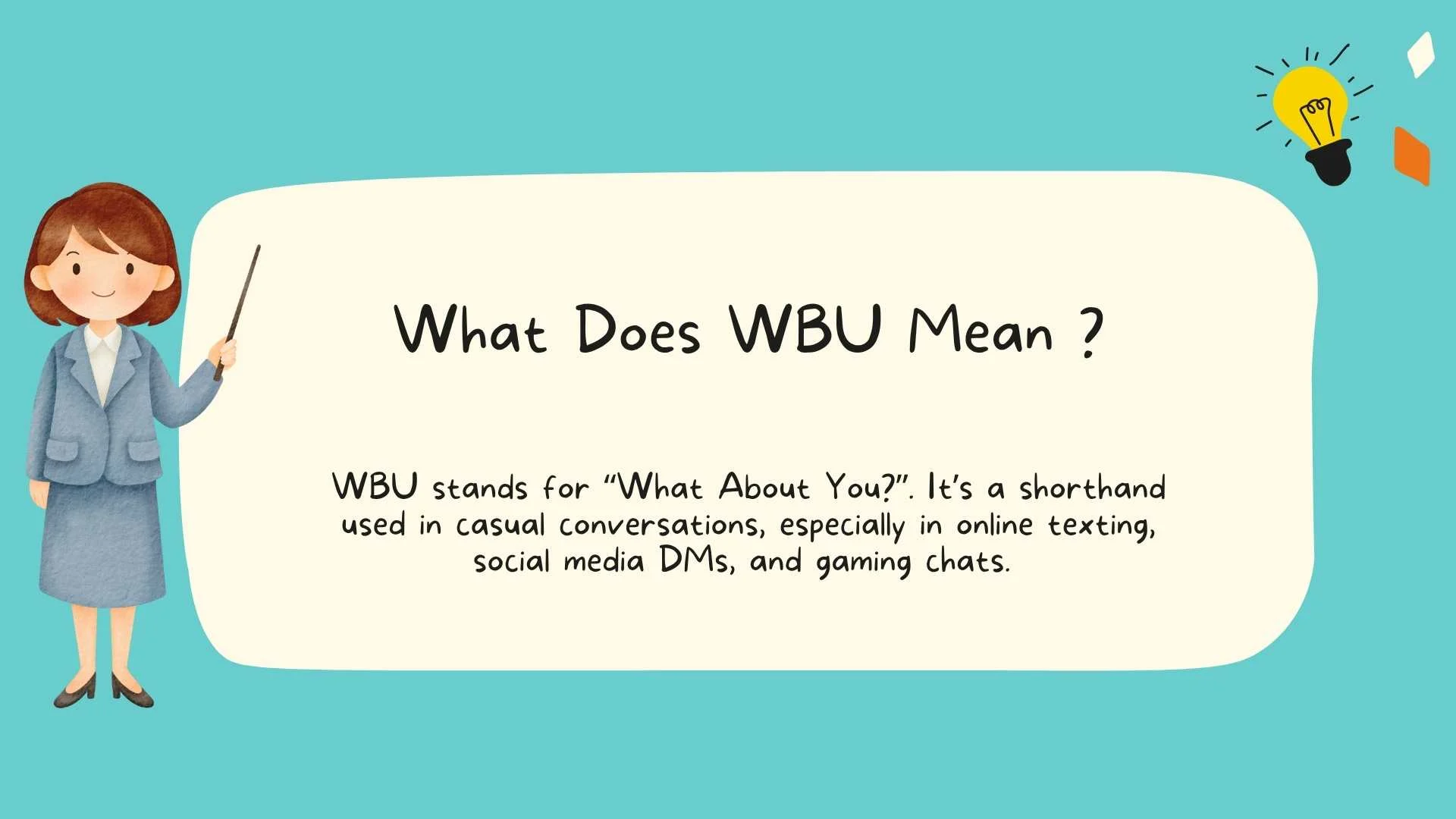
WBU stands for “What About You?”. It’s a shorthand used in casual conversations, especially in online texting, social media DMs, and gaming chats.
Essentially, it’s a reciprocal question, meaning it’s asked in response to someone sharing their status or opinion.
For example:
- Friend: “I just finished watching a new movie!”
- You: “That’s cool, WBU?”
Here, WBU signals interest in the other person’s experience while keeping the conversation flowing.
Origins of WBU
The abbreviation WBU originated in the early days of internet chatrooms and SMS texting, where people started shortening phrases to save time.
Alongside WYD (“What You Doing?”) and HBU (“How ‘Bout You?”), it became a common casual texting shortcut.
Teens and young adults quickly adopted it on WhatsApp, Instagram, Discord, and other platforms.
Today, it’s an integral part of internet slang and online messaging culture.
WBU in NLP and Linguistics
In natural language processing (NLP), WBU serves as a question-back technique.
This is a conversational strategy where a speaker responds to a statement with a question directed at the original speaker.
From a linguistic perspective, WBU plays several roles:
- Turn-taking: Maintains dialogue flow.
- Social reciprocity: Shows interest and encourages engagement.
- Semantic disambiguation: Context matters; the meaning of WBU can vary slightly depending on chat type, platform, or the age of the user.
Variants and Similar Abbreviations
Several abbreviations function similarly to WBU:
| Abbreviation | Full Form | Usage |
| HBU | How ‘Bout You? | Slightly more casual, often spoken |
| WBY | What ’Bout You? | Common in texting, similar meaning to WBU |
| WYD | What You Doing? | Focuses on current activity, not reciprocal sharing |
While these are similar, the tone and usage can differ slightly depending on the context or the platform.
WBU in Different Platforms
WBU is widely used across multiple messaging platforms:
- WhatsApp: Friendly replies in personal chats.
- Instagram DMs: Often paired with emojis to express tone.
- Discord and Telegram: Used in gaming chats and group conversations.
- TikTok comments: Popular for quick engagement in threads.
Each platform may have subtle variations, but the core meaning stays the same.
How to Use WBU in Chat
Casual Conversation
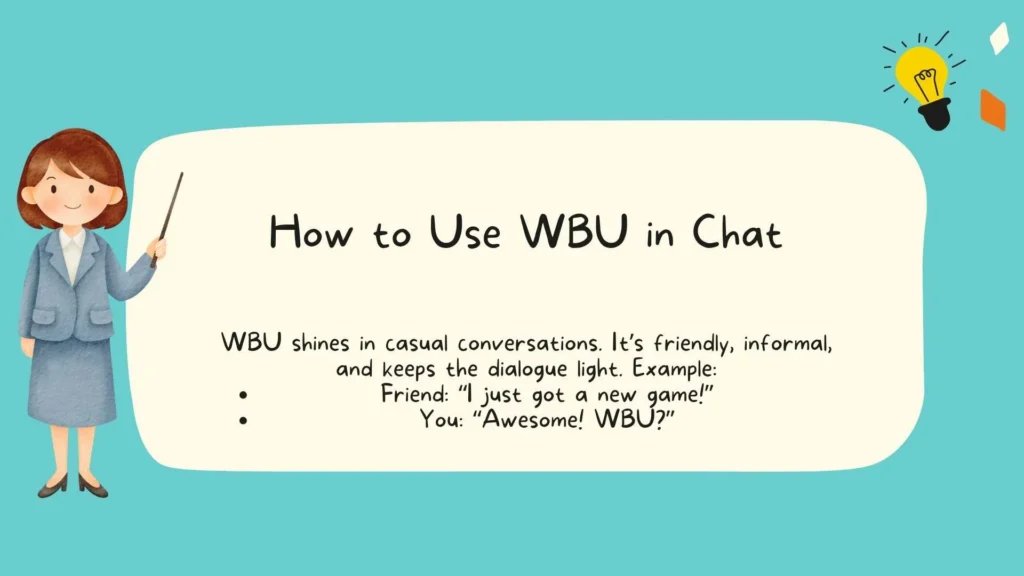
WBU shines in casual conversations. It’s friendly, informal, and keeps the dialogue light. Example:
- Friend: “I just got a new game!”
- You: “Awesome! WBU?”
Adding an emoji can help convey tone:
- “I’m good, WBU? 😄”
- “Just chilling, WBU? 🎮”
Professional or Formal Context
Avoid WBU in work emails, official documents, or school assignments. Instead, use:
- “How about you?”
- “And you?”
This ensures your message stays professional while conveying the same idea.
Replying to WBU
When someone asks you WBU, you can respond in several ways:
- “I’m good, WBU?”
- “Doing well! How about you?”
- “Busy with work, WBU?”
Notice the subtle difference in tone depending on your relationship and the chat platform.
Dos and Don’ts
Dos:
- Use with friends, family, or peers.
- Pair with casual emojis for clarity.
- Use in gaming chats or social media threads.
Don’ts:
- Don’t use in formal settings.
- Avoid with people you don’t know well.
- Don’t overuse in one conversation; it can feel repetitive.
Common Misunderstandings
New users might confuse WBU with WYD or HBU. Context is key:
- WYD asks about activity.
- HBU asks about feelings or status.
- WBU returns the question after someone shares.
WBU vs Other Chat Abbreviations
WBU vs WYD
| Abbreviation | Meaning | Usage |
| WBU | What About You? | Asks for reciprocal information |
| WYD | What You Doing? | Asks about current action |
Use WYD when asking what someone is doing right now. Use WBU to return a question after they’ve shared something about themselves.
WBU vs HBU
- HBU = How ‘Bout You? Slightly more casual and sometimes spoken verbally.
- WBU is more universally understood in online chats.
WBU vs WBY
- WBY = What ’Bout You? Almost identical in meaning, but WBU is slightly more formal in online slang hierarchy.
Similar Short Forms to Know
Other chat abbreviations often appear alongside WBU:
- LOL = Laugh Out Loud
- BRB = Be Right Back
- IDC = I Don’t Care
- IDK = I Don’t Know
- NP = No Problem
Together, these form a network of casual texting shorthand, essential for understanding teen and social media conversations.
Teen and Gen Z Chat Language
WBU is part of teen texting pragmatics. It:
- Signals interest and social bonding.
- Shows reciprocity in digital communication.
- Functions as a lightweight conversational filler that keeps the chat flowing.
NLP and Semantic Aspects of WBU
Conversational Function
From a linguistic viewpoint, WBU is a question-back technique. It:
- Maintains dialogue flow.
- Encourages reciprocal sharing.
- Acts as a social cohesion tool in online communication.
Contextual Meaning
The meaning of WBU depends on context:
- Chat context: Casual, friendly, informal.
- Formal writing: Uncommon; inappropriate.
- Cross-platform nuance: May vary slightly depending on audience or platform (Discord vs Instagram).
Text Communication Concepts
WBU is linked to multiple text communication concepts:
- Online chatting and messaging
- Social media DMs
- Gaming chat and group conversations
- Differences between informal and formal text usage
These factors are important for NLP models interpreting human language online.
Semantic Entities in WBU Usage
Entities involved when WBU is used include:
- People: friends, peers, online communities
- Platforms: WhatsApp, Instagram, TikTok, Discord
- Activities: games, social updates, feelings, tasks
Understanding these semantic entities helps in sentiment analysis and chatbot NLP interpretation.
Machine Understanding
AI and chatbots analyze WBU based on:
- Context: preceding messages, user intent
- Platform conventions: casual vs formal
- Reciprocal function: triggers the AI to respond in a conversational loop
This is crucial for automated text understanding and response generation.
Examples and Real-life Usage of WBU
Sample Text Conversations
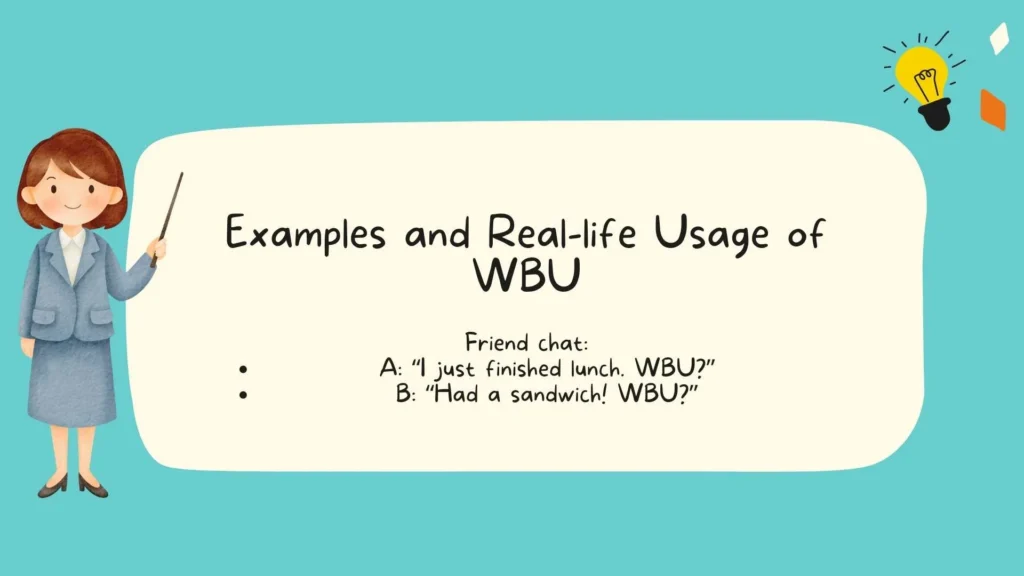
- Friend chat:
- A: “I just finished lunch. WBU?”
- B: “Had a sandwich! WBU?”
- Group chat:
- “I’m heading to the park. WBU?”
- Responses vary by participant, keeping multiple conversational threads active.
Social Media Posts
- Instagram/TikTok DMs: “Just got a new outfit! WBU?”
- Commonly paired with emojis for tone: 😎🎉
Memes and Humor
- WBU is used in internet memes to create humor based on misunderstanding or overuse.
- Example: Meme of two friends texting, both replying with WBU repeatedly.
International Usage
- Non-English speakers adopt WBU in global texting, sometimes mixing it with their native language:
- Spanish: “Estoy bien, WBU?”
- French: “Ça va, WBU?”
Teaching and Learning WBU
For beginners learning texting shortcuts:
- Recognize WBU in context
- Interpret meaning based on preceding conversation
- Practice responses in casual exercises
Example exercise:
- Scenario: Friend says, “Just finished homework!”
- Response options: “Nice! WBU?” / “Cool!” / “What are you doing?”
Correct choice: “Nice! WBU?”
Frequently Asked Questions About WBU
- What does WBU stand for?
- “What About You?”
- How do you reply to WBU politely?
- “I’m good, WBU?” or “Doing well! How about you?”
- Is WBU only for texting friends?
- Mostly yes. Avoid in professional or formal communication.
- Can WBU appear in professional communication?
- Not recommended. Stick to “How about you?”
- What is the difference between WBU, WYD, and HBU?
- WBU: Reciprocal question
- WYD: Asks what someone is doing
- HBU: Slightly casual variant of WBU
Table of WBU and Related Abbreviations
| Abbreviation | Full Form | Context | Example |
| WBU | What About You? | Casual chat | “I’m good, WBU?” |
| WYD | What You Doing? | Current activity | “WYD tonight?” |
| HBU | How ‘Bout You? | Informal chat | “I’m fine, HBU?” |
| WBY | What ’Bout You? | Casual texting | “Had lunch, WBY?” |
| LOL | Laugh Out Loud | Humor | “That’s hilarious, LOL” |
Conclusion
Understanding WBU goes beyond knowing it’s shorthand for “What About You?”.
It’s a practical tool in online conversation, a linguistic device analyzed in NLP, and a social bonding mechanism in digital communication.
By recognizing its context, platform nuances, and variants, you can use WBU naturally in texting, DMs, and casual chats, while avoiding misuse in professional settings.
Now that you know its meaning, origin, proper usage, and context, you’ll never be confused when you see WBU again.
Just remember: it’s all about keeping conversations flowing and showing interest in the other person.
Also Check These Posts:
What Does MYF Mean in Text? A Complete Guide to Modern Texting Abbreviations
What Does Season of the Sticks Mean? Origins & Symbolism Explained
What Does CTFU Mean? Your Complete Guide to This Popular Internet Slang

Ava Grace is a passionate writer who believes in the power of words to heal, inspire, and uplift. Through Quoteliy.com, she shares daily doses of motivation, love, and positivity to brighten your day. Her mission is to turn simple quotes into meaningful moments that connect hearts and spark hope.