
Have you ever read a long article, watched a video, and then tried to explain it to a friend… only to mix everything together into one simple idea?
That moment right there—that’s synthesizing in action.
We use this skill every day without even realizing it. Whether you’re studying, chatting online, or making decisions, you’re constantly combining ideas.
I’ve seen this word pop up a lot in schoolwork, online discussions, and even workplace tasks. And honestly, once you understand it, it becomes super useful in daily life.
Let’s break it down in the simplest way possible.
What Does Synthesize Mean? (Direct Answer)
To synthesize means to combine different ideas, information, or parts into one clear and complete understanding.
It’s like taking pieces from different places and blending them into a single, meaningful result that makes sense.
Meaning & Definition
At its core, synthesize means bringing things together to form something new.
Primary Meaning:
- Combine multiple ideas into one clear idea
Secondary Meanings:
- Create something new by mixing parts
- Build a summary using different sources
Simple Chat Examples:
- “I read three articles and synthesized them into one report.”
- “She synthesized all the feedback into a single plan.”
👉 Think of it like making a smoothie—you blend fruits together to create one drink.
Background & Origin
The word synthesize comes from Greek roots:
- “syn” = together
- “thesis” = placing or putting
So, it literally means “putting things together.”
It became popular in education and science first. Over time, people started using it in:
- School assignments
- Research work
- Everyday conversations
Today, it’s widely used in both academic and casual settings.
Usage in Different Contexts
Casual Chats
People use it when talking about combining ideas.
Example:
- “I watched a few videos and synthesized the main points.”
Social Media
Used in captions or educational content.
Example:
- “Thread where I synthesize all productivity tips I learned.”
Professional Use
Very common in workplaces and studies.
Example:
- “Please synthesize the data into a short report.”
Gaming / Group Chats
Sometimes used humorously.
Example:
- “We need to synthesize a plan before the next match!”
Meanings Across Platforms
| Platform | Tone | Example |
| Casual | “Let me synthesize this convo real quick” | |
| Informative | “Synthesizing my travel experience here” | |
| TikTok | Educational | “I synthesized this topic in 60 seconds” |
| Snapchat | Light | “Can you synthesize what happened?” |
| Discord | Strategic | “Let’s synthesize ideas before the raid” |
Real-Life Examples & Memes
Chat-Style Examples:
- “I read everything and synthesized it into one paragraph.”
- “Bro just synthesized the whole lecture in 2 lines 💀”
Meme-Style Lines:
- “Teacher: Synthesize the chapter
Me: So basically… everything happened 😅” - “When you synthesize but still don’t understand it 😂”
Cultural or Regional Interpretations
US / UK
- Common in education and work
- Seen as a smart skill
Asia (India, Pakistan, Philippines)
- Mostly used in academic settings
- Students often hear it in exams and assignments
Australia
- Used in universities and professional communication
Other Meanings
| Field | Meaning | Description |
| Chemistry | Chemical synthesis | Creating compounds by combining elements |
| Music | Sound synthesis | Creating sounds electronically |
| Writing | Idea synthesis | Combining sources into one idea |
| Technology | Data synthesis | Merging data for insights |
Common Mistakes & Misconceptions
- Thinking it only means “summarize” (it’s more than that)
- Using it when just copying information
- Assuming it’s only for school
- Mixing it with “analyze” (they are different steps)
Psychological / Emotional Meaning
Positive:
- Shows understanding and intelligence
- Helps in decision-making
Neutral:
- Just a thinking process
Negative:
- Can feel overwhelming if too much information is involved
Similar Terms & Alternatives
| Word | Meaning | Tone |
| Combine | Put things together | Casual |
| Merge | Join into one | Neutral |
| Integrate | Mix smoothly | Formal |
| Summarize | Shorten information | Simple |
| Analyze | Break down ideas | Technical |
Is It Offensive or Friendly?
The word synthesize is completely neutral and safe.
Friendly Example:
- “Nice job synthesizing all that info!”
Formal Example:
- “Please synthesize the findings into a report.”
👉 It’s respectful and professional in almost all contexts.
Grammar or Linguistic Insight
“Synthesize” is a verb.
Forms:
- Synthesize (present)
- Synthesized (past)
- Synthesizing (continuous)
Language evolves, and now this word is used beyond academics into daily conversations.
How to Respond
If someone uses “synthesize,” you can reply naturally like:
- “Got it, I’ll combine everything.”
- “Let me simplify it for you.”
- “Here’s the short version.”
- “I’ll put all the ideas together.”
- “Makes sense, thanks for explaining!”
Differences From Similar Words
| Word | Key Difference |
| Synthesize | Combines ideas into one |
| Summarize | Shortens content |
| Analyze | Breaks content apart |
| Explain | Makes something clear |
Relevance in Dating & Online Culture
Even in dating apps like Tinder, the idea of synthesizing shows up.
Example:
- “So basically, you love travel, food, and Netflix? Let me synthesize your vibe 😄”
Gen Z loves simplifying things fast. That’s why:
- Short summaries
- Quick insights
- “In a nutshell” content
…are all forms of synthesizing.
Popularity & Trends
With platforms like TikTok and Instagram:
- People summarize books in 60 seconds
- Threads synthesize complex topics
- Memes simplify life situations
👉 Synthesizing is now a core internet skill.
When NOT to Use “Synthesize” (IMPORTANT)
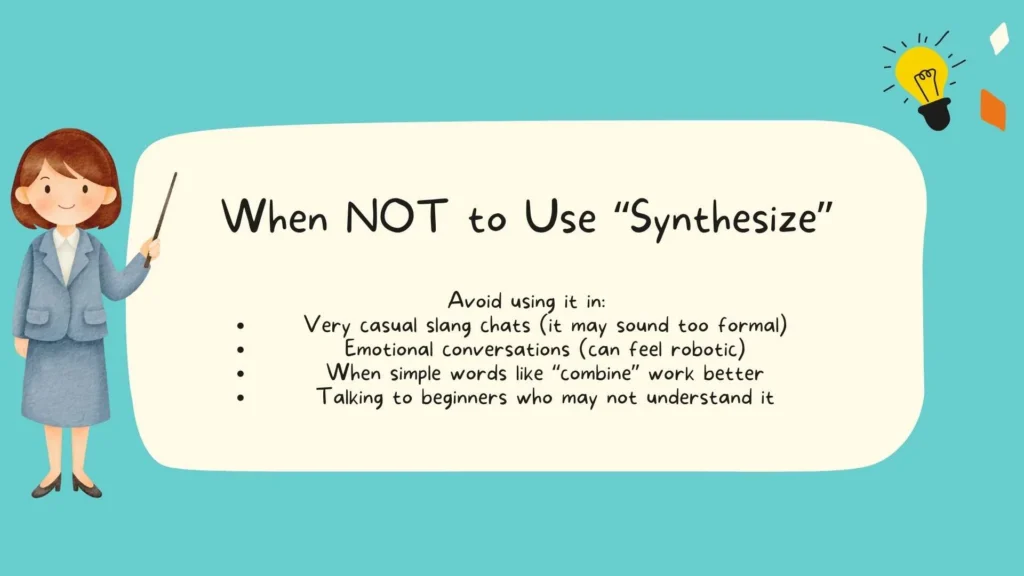
Avoid using it in:
- Very casual slang chats (it may sound too formal)
- Emotional conversations (can feel robotic)
- When simple words like “combine” work better
- Talking to beginners who may not understand it
Example to avoid:
- “Let me synthesize your feelings” ❌ (sounds awkward)
FAQs
What does synthesize mean in simple words?
It means combining different ideas into one clear and simple understanding.
Is synthesize the same as summarize?
Not exactly. Summarizing shortens content, while synthesizing combines ideas to create something new.
Where is synthesize used?
It’s used in school, work, writing, and sometimes online conversations.
Is synthesize a formal word?
Yes, it’s slightly formal but still commonly used.
Can I use synthesize in daily conversation?
Yes, but in casual chats, simpler words like “combine” may sound more natural.
Conclusion
So, what does synthesize mean?
It’s all about bringing ideas together to create something meaningful. Whether you’re studying, working, or just chatting, this skill helps you understand things better.
Once you start noticing it, you’ll realize—you’ve been synthesizing all along.
Now next time someone says “synthesize,” you won’t feel confused… you’ll feel confident 😊
Also Check These Posts:
What Does the Percentage of Rain Mean Truth Behind That Confusing Weather for 2026
What Does an Upside Down Pineapple Mean? 🍍 The Hidden Message You Might Be Missing
What Does “Complex” Mean? Simple Explanation + Real-Life Examples You’ll Actually Understand

Isabella is a passionate soul who finds beauty in words and meaning in every emotion. Through Quoteliy.com, she shares uplifting quotes that celebrate love, strength, and inner peace. Her writing reflects a heart that believes in healing through hope and inspiring others to see the light in every moment.