

In everyday conversation, you’ve probably heard the term secular thrown around, but its meaning can be surprisingly complex.
Is it just the opposite of religion? Does it refer to a philosophy, a lifestyle, or a societal condition?
Understanding what secular truly means requires diving into language, history, philosophy, and culture.
This article will explore its definitions, historical roots, cultural significance, and practical applications in modern life.
Defining ‘Secular’ – Meaning, Forms, and Contexts
The word secular originates from the Latin saecularis, meaning “of a generation” or “worldly,” and over time it has come to refer to anything non-religious or non-sacred.
While simple on the surface, its usage varies based on context, philosophy, and societal norms.
Core Definition
At its most basic, secular describes something not connected to religion or the sacred. It can apply to governments, laws, schools, or even cultural activities.
Examples in daily life:
- Public schools that do not teach religious doctrine.
- Government policies based on laws rather than religious principles.
- Holidays like Labor Day or Thanksgiving, which are civic rather than sacred celebrations.
In essence, secular spaces prioritize neutrality, allowing people of all faiths—or none—to coexist.
Secularism vs Secularity
While closely related, secularism and secularity are distinct:
- Secularism is a philosophy or ideology promoting religious neutrality in public life. It often includes the belief that religion should not interfere with governance, education, or law.
- Secularity describes the societal condition where religion is optional or private. It doesn’t prescribe belief but observes that belief is just one choice among many.
Think of it this way: secularism is the rulebook, secularity is the game in play.
Adjective vs Noun Forms
| Term | Type | Meaning |
| Secular | Adjective | Non-religious, worldly, or not sacred |
| Secularism | Noun | Philosophy advocating religious neutrality |
| Secularity | Noun | Social condition where religion is optional or private |
Example sentences:
- Adjective: The city has a secular government.
- Noun (ideology): Secularism advocates for separation of church and state.
- Noun (condition): Modern societies show high levels of secularity.
Polysemy – Multiple Meanings
Secular doesn’t only apply to religion. Its meaning shifts based on context:
- Music: Secular music contrasts with sacred or religious songs.
- Politics: Secular policies avoid privileging any faith.
- Everyday culture: Secular holidays, rituals, and civic events exist independently of religion.
This polysemy shows how context defines meaning, emphasizing the importance of linguistic and semantic understanding.
Prescriptive vs Descriptive Usage
The word secular can be used prescriptively or descriptively:
- Prescriptive: Suggests what should happen.
Example: “Secularism should guide public education to avoid religious bias.” - Descriptive: Observes reality without judgment.
Example: “Modern society is increasingly secular compared to medieval Europe.”
Recognizing the difference helps avoid confusion in discussions about ideology versus social fact.
Historical and Philosophical Context
To understand secular, it’s essential to see how it evolved across time.
Pre-modern Era
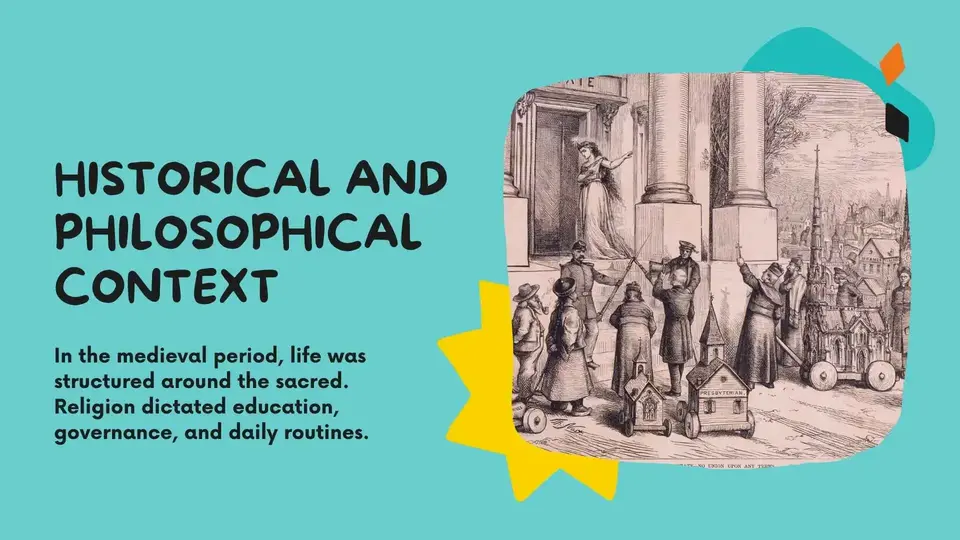
In the medieval period, life was structured around the sacred. Religion dictated education, governance, and daily routines.
The secular realm was minimal, limited to mundane, non-religious tasks like trade, farming, or civic duties.
Key point: The sacred-secular split was clear, and societal norms were deeply intertwined with religious authority.
Enlightenment Influence
The Enlightenment era brought radical change. Thinkers emphasized reason, science, and empirical evidence over divine authority.
Secularism emerged as an ideological movement advocating for public neutrality in religion and governance.
- Philosophers promoted rationalism as a guide for human decision-making.
- Knowledge and laws began to rely on empirical data rather than sacred texts.
Modern Secular Age
Charles Taylor, in A Secular Age, describes modern society as one where belief is optional.
Secularity now allows individuals to choose their faith—or reject it entirely. Western nations increasingly reflect this trend:
- Governments separate religion from law.
- Education emphasizes scientific inquiry over theological instruction.
- Society tolerates diverse beliefs and non-belief.
Example: In many countries, citizens can legally practice any religion or none, reflecting cultural secularity.
Philosophical Distinctions
Secular is often contrasted with concepts like:
- Faith vs Reason – Rational thought takes precedence over dogma.
- Belief vs Non-belief – Secularity allows coexistence of multiple worldviews.
Understanding these distinctions is critical for semantic clarity in academic or social discussions.
Contestable Beliefs
Secularism sometimes conflicts with traditional religious views. Debates arise over:
- Prayer in schools
- Laws on reproductive rights
- Public funding for religious institutions
These conflicts highlight the ideological tension between prescriptive secularism and descriptive secularity.
Cultural and Societal Perspectives
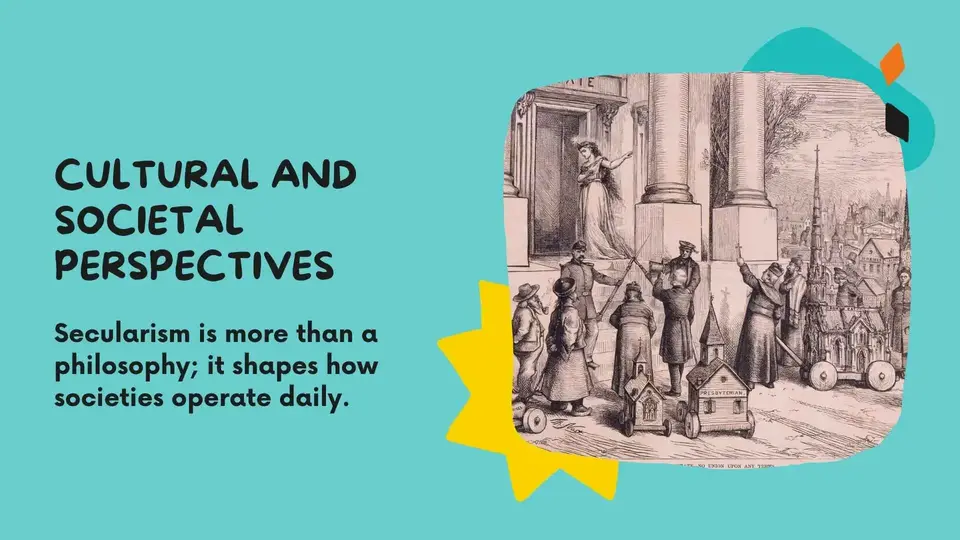
Secularism is more than a philosophy; it shapes how societies operate daily.
Secular in Daily Life
Examples:
- Public schools without religious curriculum
- Civic ceremonies like inaugurations
- Laws emphasizing human rights over religious dictates
These applications illustrate how secularism fosters inclusivity and neutrality.
Western vs Non-Western Contexts
Secularism is often associated with the Western world, but secular principles appear globally:
- Europe & North America: High levels of secularity in government and education.
- Asia: Secular laws exist alongside cultural religious norms (e.g., India).
- Middle East: Secularism is often limited, with stronger religious governance.
Understanding these differences helps frame cultural secularism in a global context.
Secularism and Human Flourishing
Secular societies often emphasize:
- Individual choice
- Scientific progress
- Civic equality
By removing religious constraints in public life, secularism can contribute to human flourishing, creativity, and societal innovation.
Sacred vs Secular Tensions
Despite neutrality, conflicts arise:
- Religious communities may feel marginalized in secular societies.
- Policies on reproductive rights, education, or scientific research can spark debates.
These tensions illustrate the balance between ideological secularism and practical secularity.
Secularism and Ideology
Some advocate prescriptive secularism—actively promoting non-religious public life. Examples include:
- New Atheists who critique organized religion.
- Activist campaigns for secular governance.
This ideological angle contrasts with descriptive observations of societal secular conditions.
Conclusion
Secularism and secularity are more than words—they shape how people live, how societies function, and how beliefs coexist in the modern world.
Understanding what secular means helps us navigate a complex landscape of ideology, culture, and personal choice.
Whether in law, education, or daily life, secularism continues to influence human flourishing, creativity, and coexistence in increasingly pluralistic societies.

Isabella is a passionate soul who finds beauty in words and meaning in every emotion. Through Quoteliy.com, she shares uplifting quotes that celebrate love, strength, and inner peace. Her writing reflects a heart that believes in healing through hope and inspiring others to see the light in every moment.