

In the fast-paced world of texting, social media, and online chats, slang terms pop up and spread like wildfire.
One term you may have seen recently is “ONG”.
If you’ve ever scrolled through TikTok comments, Snapchat messages, Instagram captions, or Discord chats and wondered, “What does ONG mean?”, you’re not alone.
This guide will break down everything you need to know about ONG meaning in text, its origin, usage, and how to respond to it safely.
Understanding slang like ONG is essential; not just to decode messages, but also to stay in touch with Gen Z slang terms and modern texting abbreviations.
Whether you’re a teen, parent, or curious adult, this article will guide you through the complete meaning of ONG in text, chat, and social media.
ONG Meaning and Full Form
Basic Definition of ONG
ONG stands for “On God”. In text messages and online chats, it’s used to emphasize truthfulness, honesty, or sincerity.
It’s essentially a shorthand for saying “I swear” or “I promise this is true”.
For example:
- “ONG, I didn’t cheat on the test.”
- “That party was amazing, ONG!”
In these cases, ONG emphasizes that the statement is genuine and not exaggerated.
Origin of ONG
The phrase “On God” has roots in urban slang and hip-hop culture.
It was originally used in spoken language to affirm truth, often in religious or serious contexts.
Over time, it migrated to social media platforms like TikTok, Snapchat, Instagram, and Discord, where teens and young adults use it casually.
TikTok trends and memes have accelerated its popularity, making ONG a common part of modern texting abbreviations.
Its usage reflects youth digital culture and how language evolves in online communication.
ONG vs OMG
It’s important to distinguish ONG vs OMG:
| Abbreviation | Full Form | Usage Purpose | Example |
| ONG | On God | Emphasize truth or sincerity | “ONG, that’s so true.” |
| OMG | Oh My God | Express surprise, shock, or amazement | “OMG! I can’t believe that!” |
While both abbreviations appear frequently in texting, they serve different emotional purposes.
Understanding the difference helps prevent miscommunication.
Why Teens Use ONG
Teens often use ONG meaning in chat to:
- Signal honesty or sincerity
- Emphasize a statement in casual conversation
- Fit in with peer groups using modern texting abbreviations
- Show agreement in digital conversations without typing a full response
In short, ONG is a versatile slang term that communicates trustworthiness or agreement quickly.
Is ONG a Bad Word?
No. ONG is generally not offensive, but context matters.
It’s appropriate in casual chats, social media comments, or private messaging.
Some parents or adults might find it unusual because it has religious origins, but it’s widely accepted as a truth-emphasizing slang term rather than profanity.
ONG Meaning in Text Messages
How ONG Appears in Chat
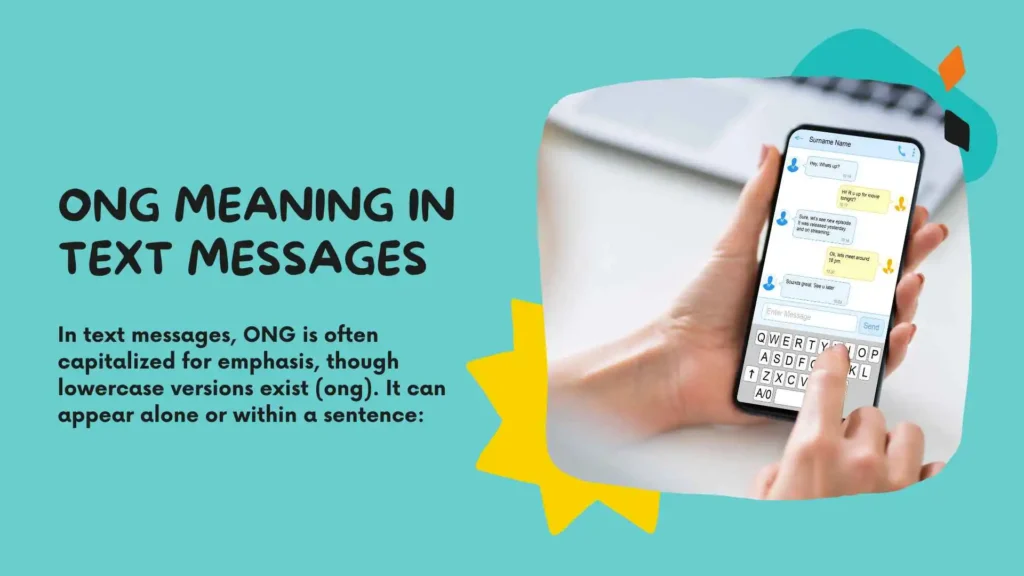
In text messages, ONG is often capitalized for emphasis, though lowercase versions exist (ong). It can appear alone or within a sentence:
- “ONG, I can’t believe she said that.”
- “That’s so true, ONG!”
The placement of ONG typically shows sincerity or agreement. Pairing it with emojis like 🙏, 😳, or 🔥 can intensify the meaning.
ONG on Snapchat
On Snapchat, teens use ONG in stories, snaps, and chat messages. It often signifies:
- Truthfulness in a conversation
- Agreement with a friend’s statement
- A casual way to emphasize honesty
Snapchat slang evolves quickly, and ONG meaning on Snapchat is firmly embedded in teen texting culture.
ONG on TikTok
TikTok is one of the main platforms where ONG has exploded in popularity. Users place ONG in:
- Captions
- Comments
- Video overlays
It’s commonly used to emphasize reactions to trends, challenges, or memes. Example:
- “ONG, this dance is harder than it looks!”
- “I tried this recipe, ONG, it was amazing!”
This usage reflects emotional expression in chats and casual online interactions.
ONG on Instagram
On Instagram, ONG shows up in:
- Comments on reels or posts
- Direct messages (DMs)
- Captions emphasizing a statement
Instagram usage often conveys agreement or excitement. For example:
- “That fit looks amazing, ONG!”
- “ONG, I needed this advice today.”
ONG on Discord
Discord communities, especially among gamers and online friend groups, use ONG to signal sincerity or agreement. It appears in:
- Server chats
- Reaction phrases
- Threaded discussions
Discord usage can be slightly more casual than other platforms, with users often combining ONG with other chat acronyms and emojis.
Examples of ONG in Text, Social Media, and Chat
Text Message Examples
- “ONG, I didn’t touch your game console.”
- “That concert was amazing, ONG!”
- “I studied all night, ONG, I deserve this grade.”
- “ONG, you’re the best friend ever.”
- “That movie was so funny, ONG!”
Snapchat and Instagram Examples
- “That story was hilarious, ONG 😂”
- “ONG, I can’t believe you did that 😳”
- “This recipe looks delicious, ONG 🙏”
- “I need this outfit, ONG 🔥”
- “ONG, that advice just saved me!”
TikTok Comment Examples
- “ONG, I’ve been trying this dance for weeks!”
- “This is the funniest trend ever, ONG!”
- “OMG vs ONG… ONG all the way 😆”
- “ONG, I relate to this so much!”
- “No cap, ONG, this is trending for a reason.”
Discord and Gaming Chat Examples
- “That strategy worked perfectly, ONG!”
- “I can’t believe we won, ONG!”
- “ONG, that boss fight was confusing!”
- “We need more players, ONG 🙌”
- “ONG, this server is lit 🔥”
Safe Examples for Teens and Parents
- Encourage teens to use ONG in positive contexts
- Avoid pairing it with arguments or negative comments
- Use as a learning opportunity to discuss online communication styles
How to Respond to ONG
Agreeing or Reacting
Responses to ONG often show agreement or excitement:
- “Same”
- “Facts”
- “No cap”
- “Deadass”
- Emojis like 🙌, 😎, or 🔥
Using ONG Yourself
Teens can use ONG to:
- Emphasize truth in messages
- Agree with friends quickly
- Add casual social media flair
Dos and Don’ts:
- ✅ Do: Use it for sincerity
- ❌ Don’t: Overuse it or pair it with rude messages
Responding as a Parent
Parents can respond to teen slang by:
- Understanding context and tone
- Asking gently: “What does that mean?”
- Avoiding judgment, fostering parent-child communication
Misinterpretation Risks
- ONG may be misunderstood if the recipient is unfamiliar with slang
- Tone and platform matter (Snapchat vs Discord)
- Clarify meaning when in doubt to avoid digital miscommunication
Alternative Slang Expressions
Other truth-emphasizing slang includes:
| Slang Term | Meaning | Example |
| No cap | Honestly, no lie | “No cap, that was amazing” |
| Deadass | Seriously, truly | “Deadass, I can’t believe it” |
| Facts | Totally true | “Facts, that was the best movie” |
| I swear | Emphasizing truth | “I swear, I didn’t cheat” |
| Fr | For real | “Fr, this food is fire” |
Parent-Friendly Guide to Understanding ONG and Teen Slang
Why Parents Should Learn Teen Slang
- Keeps you informed about youth online language
- Improves digital communication safety
- Helps monitor social media and texting behavior
Slang Evolution and Teen Communication
- Slang like ONG evolves rapidly due to social media trends
- Teens create shorthand for efficiency and emotional expression
Tips for Talking to Teens About Slang
- Ask open-ended questions: “What does ONG mean?”
- Encourage explanation without judgment
- Discuss appropriate contexts for slang use
Tools for Parents
- Online slang dictionaries
- Trend monitoring on TikTok, Instagram, Snapchat
- Apps like Urban Dictionary, Teen Slang Guides
Safe Usage Guidelines
- Teach teens to use slang respectfully
- Avoid pairing with offensive words
- Encourage positive online interactions
Summary and Key Takeaways
- ONG meaning in text = On God, emphasizes honesty or truth
- Used widely on Snapchat, TikTok, Instagram, Discord
- Teens use it to communicate sincerity, agreement, or excitement
- Distinguish ONG vs OMG for clarity in conversation
- Parents can stay informed to promote safe, responsible online communication
- Understanding slang fosters better parent-child communication and digital literacy
Frequently Asked Questions About ONG
Is ONG only used by Gen Z?
Mostly, yes. Gen Z popularized it online, but anyone familiar with digital culture can use it.
Where does ONG come from?
It comes from the phrase “On God”, originating in urban slang and hip-hop culture.
Can adults use ONG?
Yes, but it may sound unusual unless they’re familiar with social media slang.
Is ONG considered disrespectful?
No. It’s generally safe in chats, texts, and social media comments.
Why is ONG popular on TikTok?
TikTok trends amplify casual slang. Teens and creators use it to emphasize honesty in captions and comments.
How should parents react to slang?
Stay curious, not judgmental. Understanding the term fosters digital literacy and better communication.
What is the difference between ONG and OMG?
ONG = honesty, emphasis (“On God”).
OMG = surprise, shock (“Oh My God”).
Conclusion
ONG meaning in text shows honesty or emphasizes truth across platforms like TikTok, Snapchat, Instagram, and Discord.
Mostly used by Gen Z, it helps teens express sincerity quickly.
Parents who understand ONG can better navigate teen texting culture and online conversations.
Knowing its context and differences from terms like OMG prevents miscommunication and keeps chats positive.
Also Check These Posts:
What Does Broil Mean? The Complete Guide to Broiling, Broilers, and High Heat Cooking at Home
What Does SOL Mean? Full Guide to SOL in Text, Science, Business and Pop Culture
What Does Eau de Toilette Mean? The Complete Guide to EDT
What Does “Fein” Mean Travis Scott? Understanding the Slang, Merch and Fandom Culture

Isabella is a passionate soul who finds beauty in words and meaning in every emotion. Through Quoteliy.com, she shares uplifting quotes that celebrate love, strength, and inner peace. Her writing reflects a heart that believes in healing through hope and inspiring others to see the light in every moment.