

When it comes to criminal law, the term “no contest” often confuses defendants, lawyers, and even the general public.
Many people assume it’s the same as pleading guilty, but the legal nuances are significant.
In simple terms, a no contest plea, or nolo contendere, allows a defendant to accept conviction without admitting guilt.
This distinction can be crucial in cases where civil liability may follow criminal charges.
In this article, we’ll break down what no contest means, its legal history, effects, practical applications, and the pros and cons of choosing this plea.
Definition of No Contest in Legal Terms
What Nolo Contendere Literally Means
Nolo contendere is a Latin phrase that translates to “I do not wish to contend.”
Unlike a guilty plea, it allows a defendant to acknowledge the charges without formally admitting wrongdoing.
Courts treat a no contest plea as a conviction for criminal purposes, but in civil proceedings, it may not serve as evidence of liability.
Example: Suppose a driver is charged with a minor traffic violation that could lead to a civil lawsuit if a car accident occurred.
Pleading no contest lets the driver resolve the criminal matter without admitting fault in a potential civil case.
Legal Standing and Recognition
Not all courts allow a no contest plea.
In the United States, most state courts accept it, but federal courts are more restrictive. Some states restrict its use in felony cases or serious crimes.
Table: Plea Type Comparison
| Plea Type | Criminal Conviction | Civil Liability | Public Record |
| Guilty | Yes | Can be used as evidence | Guilty |
| Not Guilty | No | Cannot be used | Not guilty |
| No Contest | Yes | Generally not used as evidence | Conviction |
Key Legal Effects of a No Contest Plea
- Criminal conviction equivalent to guilty plea: Courts sentence defendants similarly to a guilty plea.
- Civil liability protection: Defendants avoid explicitly admitting fault, which may protect them in lawsuits.
- Court efficiency: Judges sometimes favor no contest pleas to expedite resolution.
Example: In minor DUI or traffic cases, defendants may enter a no contest plea to avoid civil liability with their insurance companies.
Restrictions and Conditions
No contest pleas are not universally available.
Certain violent crimes or felony charges may prohibit their use. Judges have discretion to reject a plea if it doesn’t serve justice or if the law forbids it.
Understanding these jurisdiction-specific rules is crucial for defendants considering this strategy.
Differences From a Guilty Plea
While a no contest plea and a guilty plea may result in similar criminal sentences, the key difference lies in admission of guilt.
Guilty pleas serve as an explicit acknowledgment of wrongdoing, which can be used in civil litigation.
No contest pleas avoid that, providing a strategic advantage when civil suits are possible.
History and Origins of the No Contest Plea
Latin Roots and Common Law Adoption
The concept of nolo contendere originates from English common law, where it was used to streamline court procedures and protect defendants from unnecessary civil exposure.
Early U.S. legal systems adopted it to balance efficient court administration with individual rights.
Adoption Across U.S. States
The acceptance of no contest pleas varies by state. Some states permit it for misdemeanors and lesser offenses but restrict it for felonies.
Others allow it under specific conditions with court approval.
Table: State-by-State Acceptance of No Contest Pleas
| State | Accepts No Contest Plea? | Restrictions |
| California | Yes | Felonies require court approval |
| Texas | Yes | Limited for violent felonies |
| New York | Limited | Only in minor offenses |
| Florida | Yes | Cannot be used for serious felonies |
| Federal Courts | Rarely | Special permission required |
Rationale Behind Its Creation
The plea was designed to:
- Avoid defendants admitting guilt publicly.
- Protect them in related civil actions.
- Increase court efficiency by resolving cases quickly.
It creates a balance between accountability and strategic defense, especially in cases where civil liability is a concern.
High-Profile Historical Cases
Some defendants have entered no contest pleas in high-profile cases, notably in traffic violations or corporate misconduct.
While the media often reports these as guilty pleas, legally, the distinction can significantly affect civil lawsuits and public perception.
International Perspective
Other countries handle equivalent pleas differently.
For example, many European legal systems emphasize formal admissions of guilt, making nolo contendere uncommon.
The U.S. system is relatively unique in allowing this plea as a strategic tool in criminal and civil intersection cases.
Legal Implications in Criminal Cases
Impact on Sentencing
Courts treat no contest pleas similarly to guilty pleas regarding sentencing.
Defendants may face fines, probation, or imprisonment, depending on the offense.
However, judges sometimes view no contest pleas as a cooperative gesture, which can influence leniency.
Criminal Record Considerations
A no contest plea results in a conviction on the criminal record.
Future employers, law enforcement, or immigration authorities will see it as a conviction, but it may avoid explicit admission of guilt that could affect civil proceedings.
Civil Liability Protection
One of the primary advantages of a no contest plea is limiting civil exposure. In many cases, the plea cannot be used as evidence in civil lawsuits.
This is particularly important in personal injury, property damage, and malpractice cases.
Example: A corporate executive charged with regulatory violations may enter a no contest plea to avoid civil suits while accepting criminal sentencing.
Plea Bargaining Strategy
Lawyers often recommend no contest pleas as part of plea bargaining. It can be a tactical move to:
- Avoid admitting guilt in related civil litigation.
- Negotiate reduced charges or fines.
- Resolve cases faster without prolonged trial proceedings.
Judicial Perspective
Judges consider several factors before accepting a no contest plea:
- Severity of the crime.
- Defendant’s legal representation.
- Potential impact on civil lawsuits.
- Compliance with state and federal rules.
Practical Scenarios Where No Contest Pleas Are Common
Traffic Offenses
- Minor collisions, DUI infractions, speeding tickets.
- Avoids admission of civil liability while resolving criminal charges.
Misdemeanors
- Petty theft, simple assault, or public disturbances.
- Prevents defendants from admitting guilt that could lead to lawsuits.
Corporate and White-Collar Crime
- Fraud, accounting irregularities, or regulatory violations.
- High-stakes cases where civil lawsuits are likely.
Plea in Civil-Medical Liability Cases
- Doctors or medical staff facing malpractice allegations may enter no contest pleas to resolve criminal charges without admitting negligence in civil claims.
Family Law Cases
- Domestic disputes or protective order violations.
- Limited use, but occasionally employed to avoid civil consequences.
Pros and Cons of Pleading No Contest
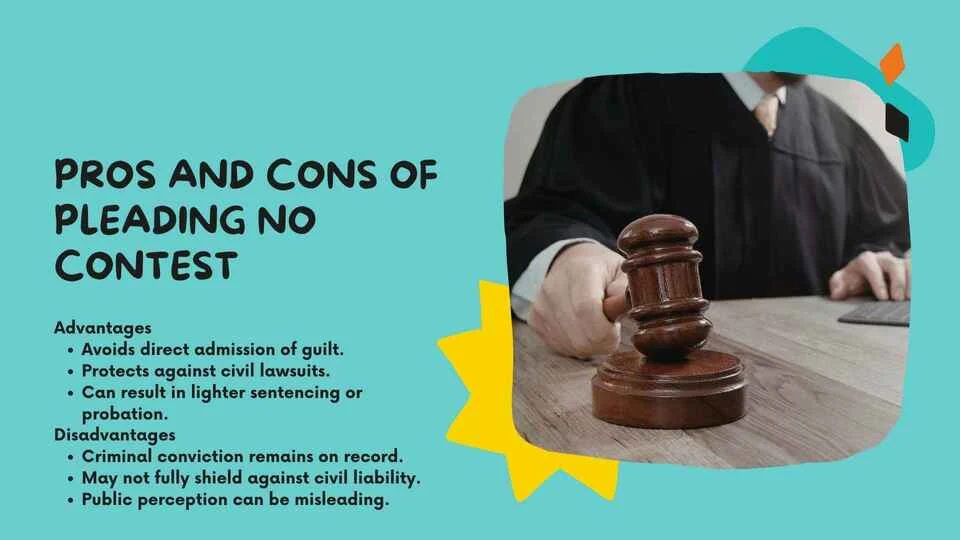
Advantages
- Avoids direct admission of guilt.
- Protects against civil lawsuits.
- Can result in lighter sentencing or probation.
Disadvantages
- Criminal conviction remains on record.
- May not fully shield against civil liability.
- Public perception can be misleading.
Strategic Considerations
Choosing a no contest plea requires legal guidance. Factors include:
- Severity of the charges.
- Civil litigation risk.
- Jurisdiction-specific rules.
Risk Assessment
Defendants must weigh:
- Potential criminal penalties.
- Civil exposure.
- Public and professional consequences.
Real-Life Examples
- Celebrities and executives have used no contest pleas in DUI or regulatory cases.
- Outcomes often differ from guilty pleas, especially in civil ramifications.
Related Legal Terms and Concepts
Guilty Plea vs No Contest vs Not Guilty
| Plea Type | Admission of Guilt | Criminal Record | Civil Use |
| Guilty | Yes | Yes | Evidence |
| Not Guilty | No | No | N/A |
| No Contest | No formal guilt | Yes | Usually not used |
Nolo Contendere in Civil Litigation
While no contest pleas generally protect against civil use, certain jurisdictions allow exceptions.
Tort cases, personal injury, or negligence lawsuits may still reference the underlying facts indirectly.
Plea Bargaining and Court Strategy
No contest pleas often form part of a broader plea bargaining strategy.
Defendants negotiate charges, fines, or probation while limiting exposure in civil proceedings.
Criminal Record Sealing and Expungement
- Sealing or expungement rules vary by state.
- Some jurisdictions treat no contest convictions like guilty pleas for record purposes.
- Legal counsel is essential for navigating expungement eligibility.
Public Perception and Media Coverage
Media often misreports no contest pleas as guilty pleas, leading to misconceptions.
Understanding the distinction is critical for defendants and their legal teams.
FAQs About No Contest Pleas
- Can a no contest plea be changed later?
Rarely; it usually requires court approval or appeal. - Does pleading no contest affect immigration status?
Potentially, depending on the offense and federal guidelines. - Will insurance companies treat it differently than a guilty plea?
Some do; policies vary. - Can minors plead no contest?
In certain jurisdictions, yes, often with court approval. - Are no contest pleas ever used in federal cases?
Rarely, only with special permission from the court.
Conclusion
A no contest plea or nolo contendere is a powerful legal tool when used correctly.
It allows defendants to accept criminal conviction without admitting guilt, providing potential protection in civil litigation and offering strategic advantages in court.
However, it carries limitations, public perception challenges, and jurisdiction-specific restrictions.
Understanding the nuances, historical context, and practical implications ensures informed decision-making in the legal process.

Bonnie Mae is a thoughtful writer with a deep love for words that inspire and heal. At Quoteliy.com, she shares heartfelt quotes about life, love, and self-growth — each crafted to bring peace and positivity to your day. Her passion lies in turning simple thoughts into meaningful reflections that touch hearts and spark hope.