

Have you ever felt emotionally drained, unimpressed, or simply indifferent after experiencing too much of the same thing?
If so, you’ve likely felt jaded. This word carries centuries of history, evolving meaning, and cultural significance.
From its origins describing tired horses to its modern sense of mental weariness, understanding jaded requires exploring language, literature, and psychology.
In this article, we’ll dive deep into the meaning of jaded, its etymology, semantic shifts, cultural impact, idiomatic expressions, and applications.
We’ll also examine real-world examples and provide practical insights for recognizing and coping with jadedness in everyday life.
The Origins of “Jaded”: From Horses to Human Emotion
Etymology and Historical Roots
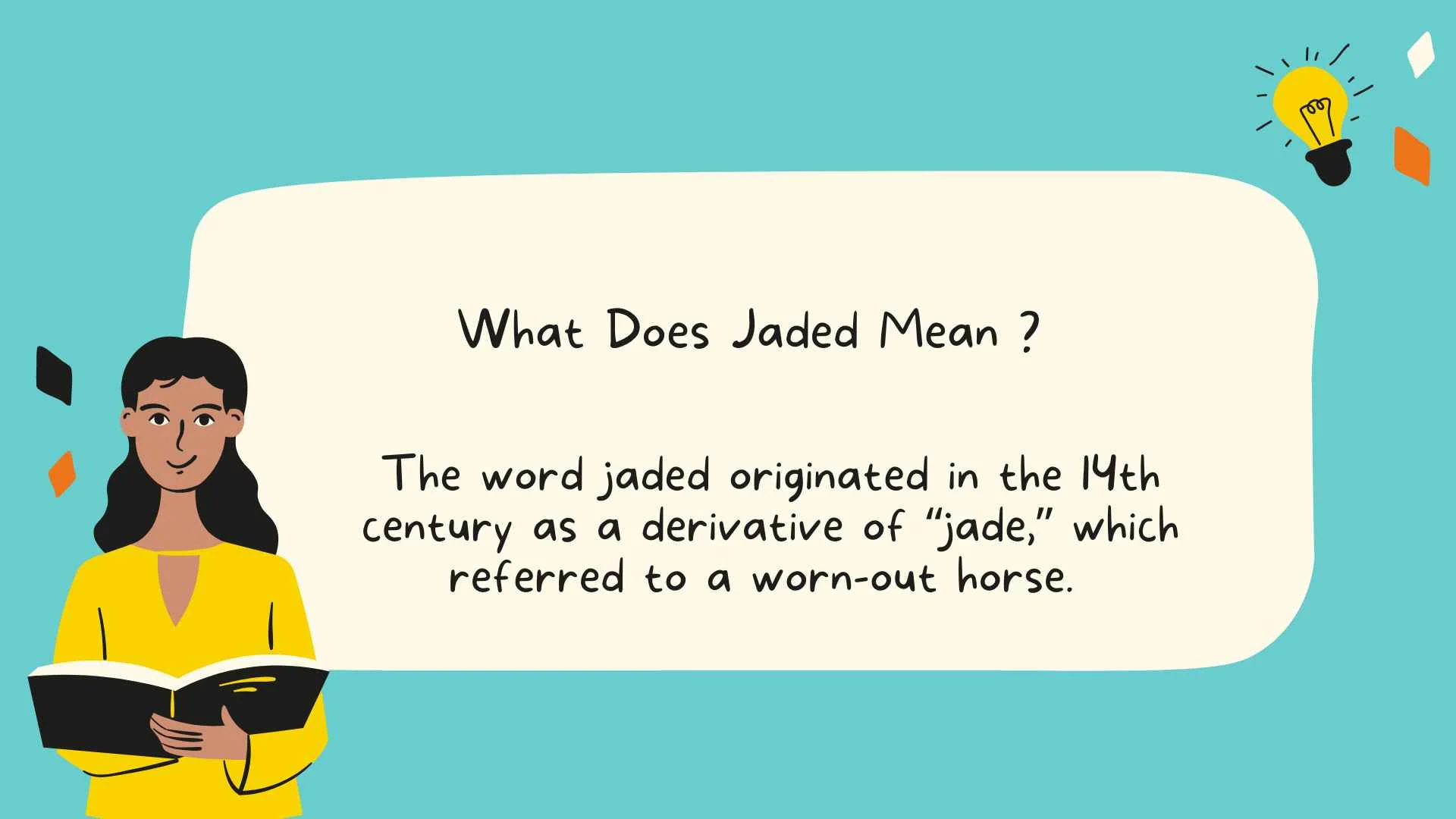
The word jaded originated in the 14th century as a derivative of “jade,” which referred to a worn-out horse.
Early forms appear in Scottish and Icelandic texts, indicating that the term was used to describe tired or overworked animals.
Over time, “jade” became a verb, meaning “to tire out or exhaust,” reflecting the action of overworking something or someone.
Timeline of Word Evolution:
| Year | Term | Meaning |
| 14th century | jade | worn-out horse |
| 1598 | jade (verb) | to tire out, to exhaust |
| 1913 | jaded | emotionally or physically worn |
| 1962 | jaded (Steinbeck) | mental weariness and sensory overload |
The transformation from describing animals to describing humans is a classic example of semantic shift, where meaning evolves to fit new contexts.
Today, jaded primarily describes mental weariness, indifference, or emotional exhaustion.
Historical Dictionaries and Documentation
Several dictionaries have tracked the evolution of jaded:
- Webster’s New International Dictionary (1913 edition): Listed “jaded” as overworked or worn-out, mostly in physical contexts.
- Merriam-Webster’s Ninth Collegiate Dictionary (1983 edition): Broadened the meaning to include emotional weariness.
- Roget’s Thesaurus (1994 edition): Classified synonyms like exhausted, satiated, and wearied.
These sources help us see how jaded evolved from physical to emotional and cultural contexts.
Semantic Shift Over Time
The meaning of jaded shifted gradually:
- Physical exhaustion: Originally referred to tired horses.
- Mental fatigue: Expanded to humans experiencing overwork or overstimulation.
- Emotional indifference: Modern usage often implies cynicism or boredom with repetitive experiences.
This semantic change demonstrates the importance of lexical semantics, the study of how word meanings develop over time.
Collocations and Contextual Meaning
Words surrounding jaded in text provide clues to meaning. Common phrases include:
- “Dulled by surfeit or excess” – reflecting overstimulation.
- “Been around” – implying experience leads to indifference.
- “Done it all” – expressing emotional weariness after repeated exposure.
These collocations show how context influences interpretation, an essential concept in NLP tasks like word sense disambiguation (WSD).
Hypernyms and Hyponyms
Understanding jaded also involves examining its semantic hierarchy:
- Hypernyms (broader terms): exhausted, fatigued, overworked.
- Hyponyms (more specific): cynical, indifferent, emotionally numb.
Recognizing these relationships helps NLP systems and human readers differentiate between subtle shades of meaning.
Understanding the Modern Meaning of Jaded
Core Definitions
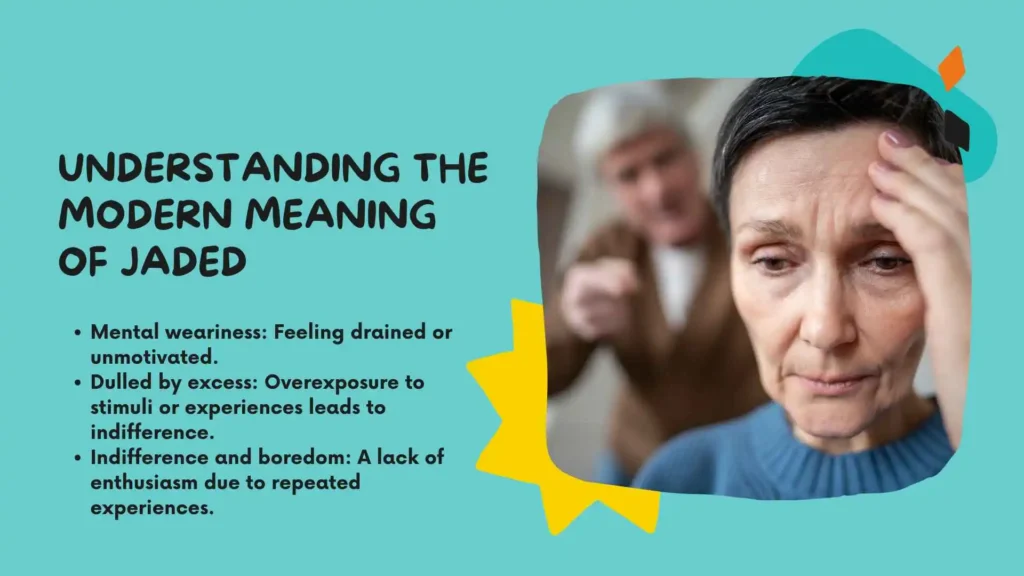
Today, jaded usually describes emotional and psychological states:
- Mental weariness: Feeling drained or unmotivated.
- Dulled by excess: Overexposure to stimuli or experiences leads to indifference.
- Indifference and boredom: A lack of enthusiasm due to repeated experiences.
For example, someone who has traveled extensively and seen the world may feel jaded, losing excitement over what once thrilled them.
Jaded in Literature and Culture
John Steinbeck in Travels with Charley (1962) illustrates jadedness through sensory overload during his road trip across the United States.
The narrator notes both the beauty of the landscape and the emotional fatigue that comes from constant exposure.
The Ecclesiastes biblical text similarly touches on human weariness: “What has been will be again; what has been done will be done again; there is nothing new under the sun.”
Modern authors like Kathleen Norris explore jadedness in everyday life, emphasizing subtle emotional exhaustion in contemporary contexts.
Synonyms and Semantic Similarity
Jaded shares semantic similarity with words that convey exhaustion, indifference, or emotional numbness:
- Exhausted
- Indifferent
- Satiated
- Wearied
- Worn out
- Sick of it
Synonyms vary depending on context; a person might feel satiated from luxury but wearied from emotional strain.
Idiomatic Expressions and Everyday Usage
Idioms often capture the figurative meaning of jaded:
- “Been around” – implying experience has dulled enthusiasm.
- “Done it all” – emotional or experiential saturation.
- “Sick of it” – straightforward expression of indifference.
In media and journalism, phrases like these convey subtle emotional states without explicitly saying “jaded.”
Cultural Semantics and Sensory Overload
Modern life intensifies feelings of jadedness. Constant exposure to news, entertainment, and social media creates a sensory-overloaded culture.
This contributes to emotional desensitization, where stimuli that once excited or engaged us feel dull or unremarkable.
Example: Viewing a breathtaking painting in a crowded gallery might not elicit awe if someone is emotionally jaded from repeated overstimulation.
Linguistic and NLP Perspectives on “Jaded”
Word Sense Disambiguation (WSD)
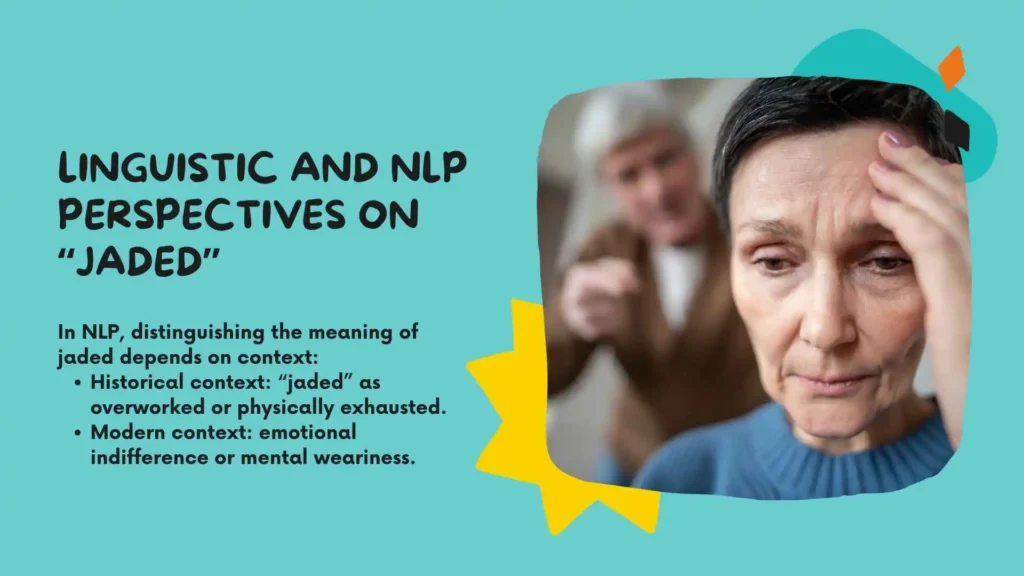
In NLP, distinguishing the meaning of jaded depends on context:
- Historical context: “jaded” as overworked or physically exhausted.
- Modern context: emotional indifference or mental weariness.
WSD ensures algorithms recognize these differences, preventing misinterpretation in text analysis or sentiment detection.
Lexical Semantics and Semantic Similarity
NLP systems evaluate semantic similarity to group words like exhausted, satiated, and wearied with jaded.
This allows chatbots, recommendation systems, and content analyzers to understand nuanced emotional states.
Corpus Analysis and Historical Linguistics
By analyzing digital corpora across decades, linguists can trace the semantic shift of jaded. For instance:
| Source | Year | Usage Context |
| 1913 Dictionary | Physical exhaustion | Overworked horse or person |
| 1983 Dictionary | Emotional weariness | Human psychological state |
| Literature | 1962 | Sensory overload in road trip narratives |
This temporal analysis helps understand both historical and modern meanings.
Collocation Analysis
NLP identifies patterns where jaded co-occurs with words like:
- Excess, bored, experienced, tired, indifferent
Collocation analysis improves machine translation, text summarization, and sentiment analysis.
Sentiment and Affect Analysis
Texts containing jaded often carry emotional undertones:
- Boredom
- Disillusionment
- Fatigue
Sentiment analysis algorithms can detect these emotional nuances in social media, literature, and news articles.
Psychological and Social Aspects of Feeling Jaded
Emotional Weariness
Overwork, repetitive experiences, and overstimulation contribute to jadedness.
Emotional fatigue often manifests as a lack of enthusiasm for activities that previously brought joy.
Boredom vs Jadedness
Boredom is temporary and situational, while jadedness implies long-term emotional fatigue from repeated exposure.
Recognizing this distinction helps in both psychological assessment and daily self-awareness.
Overstimulation in Modern Society
Modern urban life and social media amplify sensory overload. Constant notifications, advertisements, and media content reduce the ability to experience novelty, leading to emotional jadedness.
Coping Strategies
Practical tips for combating jadedness include:
- Taking breaks from routine.
- Engaging in novel experiences.
- Practicing mindfulness and meditation.
- Reducing exposure to overstimulating media.
These strategies help restore enthusiasm and mental energy.
Cultural Reflections
Literature, film, and journalism often depict jaded characters as world-weary or emotionally detached.
These portrayals reflect society’s fascination with the “experienced but disillusioned” archetype.
Related Words and Expressions
Synonyms and Near-Synonyms
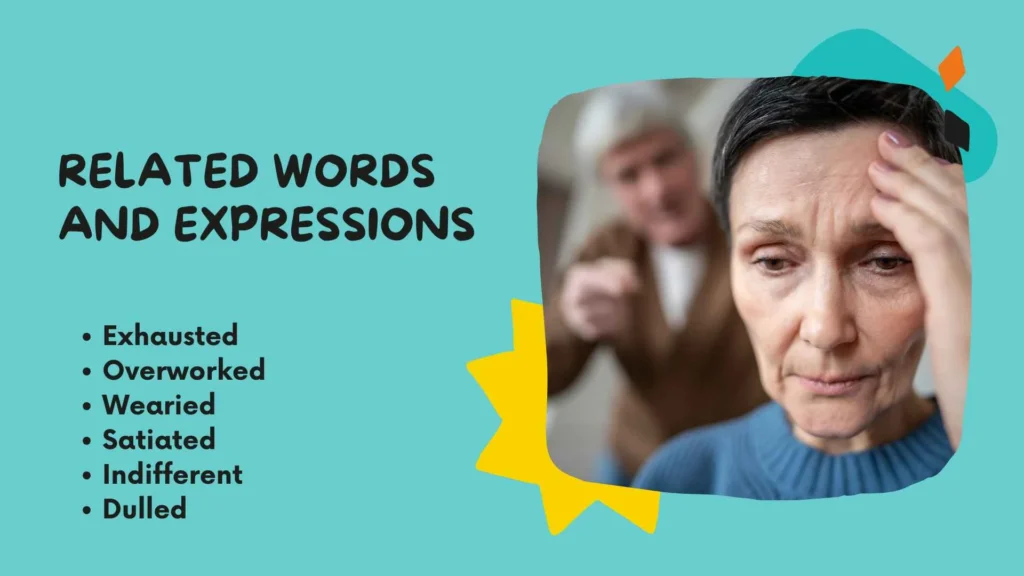
- Exhausted
- Overworked
- Wearied
- Satiated
- Indifferent
- Dulled
Antonyms
- Fresh
- Enthusiastic
- Curious
- Eager
- Unspoiled
Verbing and Word Evolution
The transition of “jade” from noun to verb highlights how language adapts, influencing adjectives like jaded.
Idioms and Colloquialisms
- “Been around the block” – experienced and indifferent.
- “Done it all” – emotional saturation.
- “Sick of it” – plain expression of jadedness.
Cross-Cultural Comparisons
Many languages have terms capturing emotional fatigue, cynicism, or overstimulation, reflecting universal human experiences.
Conclusion
Jaded describes emotional and mental weariness, evolving from worn-out horses to humans dulled by experience.
It reflects indifference, boredom, and overstimulation common in modern life. Literature, idioms, and historical dictionaries show its rich history and cultural significance.
Understanding synonyms like exhausted, satiated, and wearied helps grasp its nuances. Feeling jaded signals the need to pause, reflect, and reset.
Practical strategies like seeking novelty or taking breaks can restore enthusiasm.
Ultimately, recognizing jadedness allows you to regain curiosity and approach life with renewed energy.

Ava Grace is a passionate writer who believes in the power of words to heal, inspire, and uplift. Through Quoteliy.com, she shares daily doses of motivation, love, and positivity to brighten your day. Her mission is to turn simple quotes into meaningful moments that connect hearts and spark hope.